Nether Marketing · September 2026 · AI Search & Local SEO
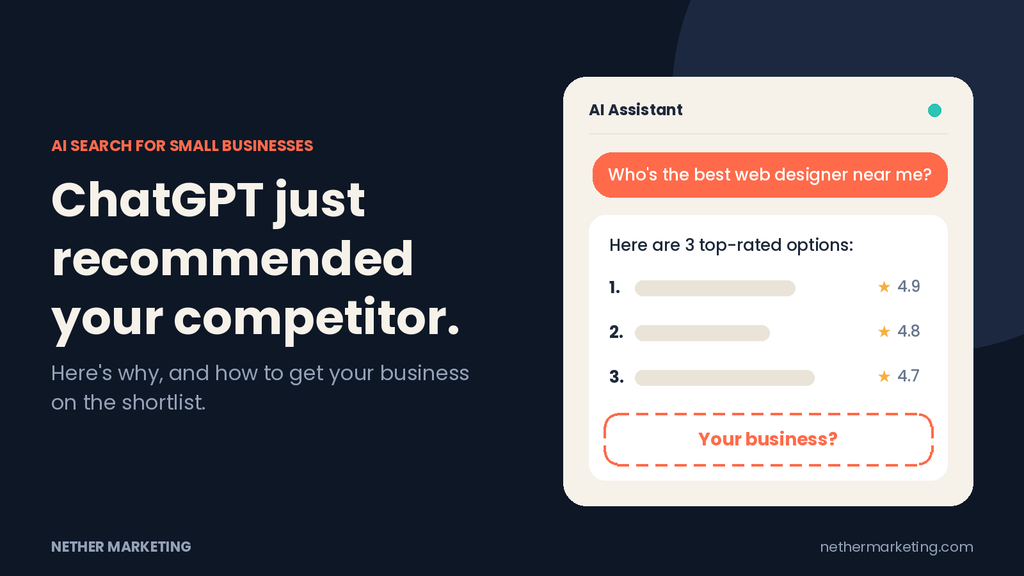
It’s 9 p.m. and a homeowner’s water heater just gave out. Instead of scrolling through a page of Google results, she opens ChatGPT and types, “Who’s the most reliable plumber near me?” Within seconds she has three names, a one-line reason to trust each one, and a decision to make. She calls the second name on the list.
If your business wasn’t on that list, you didn’t just lose a ranking. You lost a job, and you’ll never know the conversation happened.
That scene now plays out thousands of times a day. AI search for small businesses isn’t a future trend anymore. It’s how a huge share of your customers already shop. The good news is that the businesses AI recommends aren’t necessarily the ones with the biggest budgets. They’re the ones that are easiest to understand and easiest to trust. Below, we’ll cover what changed, why your website matters more than ever, and what you can do about it this week.
Your Customers Changed How They Search
For about twenty years, finding a local business meant typing a few words into Google and picking from a list of links. In 2026, that habit is shifting fast.
BrightLocal’s 2026 Local Consumer Review Survey found that 45% of consumers used AI tools such as ChatGPT, Gemini, or Perplexity to get local business recommendations, up from only 6% the year before. That jump makes AI the third most popular place to find a local business, trailing only Google and Facebook. A separate study from Yext found that 47% of U.S. adults had used AI to look for a local business in just the previous month.
Google is moving in the same direction. In May 2026, the company announced that AI Mode, its conversational search experience, had passed one billion monthly users, while AI Overviews (the AI summaries that appear above regular results) now reach more than 2.5 billion.
And when AI answers the question right on the results page, fewer people click through. A Pew Research Center study found that Google users clicked a traditional search result on 8% of visits when an AI summary appeared, compared with 15% when no summary was shown. Links inside the AI summary were clicked on only about 1% of visits.
The takeaway: ranking on page one doesn’t guarantee what it used to. Being part of the answer does.
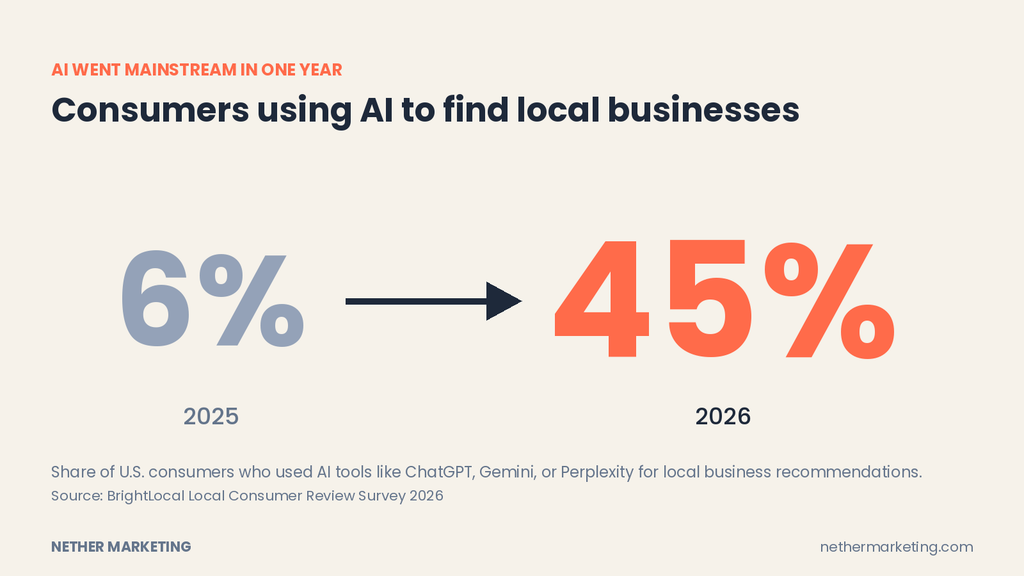
AI went from a niche habit to a mainstream way to find local businesses in a single year.
AI Doesn’t Hand Out Ten Options. It Picks Two or Three.
Google shows a list and lets the customer choose. AI does the choosing first. It gathers what it can find about businesses in your area, weighs it, and hands the customer a short list, sometimes a single name.
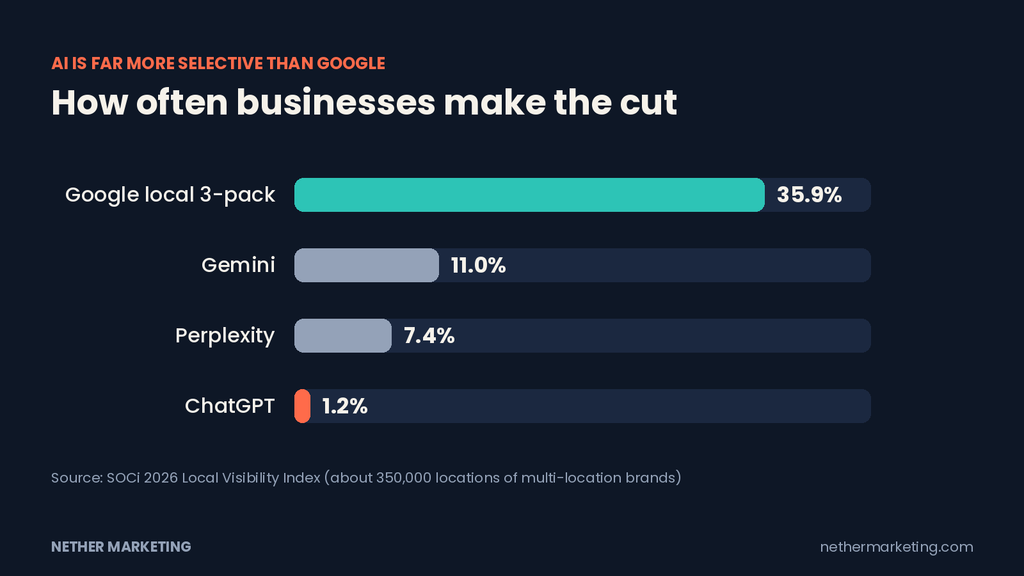
That makes an AI recommendation much harder to earn than a spot in search results. SOCi’s 2026 Local Visibility Index looked at roughly 350,000 locations belonging to multi-location brands. Those businesses appeared in Google’s local 3-pack (the map results) about 35.9% of the time. ChatGPT recommended just 1.2% of them. Gemini recommended 11%, and Perplexity 7.4%.
Two more findings should get every business owner’s attention. First, doing well on Google doesn’t automatically carry over. SOCi found that fewer than half of the brands leading traditional local search were also among the most visible in AI recommendations. Second, each AI tool pulls from different places. When Steady Demand ran nearly 1,500 identical local searches through Gemini and ChatGPT, the two tools named the same top business only 4.2% of the time. Gemini leaned heavily on business websites, while ChatGPT relied more on Reddit and online directories.
In other words, standing out now means being clear and consistent everywhere AI looks, not just on Google. If that sounds like the attention problem we covered in The Brands Winning in 2026 Are Winning Attention, it is. AI simply raises the stakes.
Earning an AI recommendation is far harder than showing up in Google’s map results.
Ask, Verify, Act: Why Your Website Matters More Now
Here’s the part most “AI SEO” advice misses: AI might put you on the shortlist, but it almost never closes the sale.
Yext’s 2026 Consumer Search Behaviors Report found that only 5% of people go directly from an AI recommendation to a purchase. Nearly everyone else checks AI’s homework first. After getting a recommendation, 53% search Google or Bing to learn more, 49% go straight to the business’s website, 28% look up reviews, and 20% visit the business’s social media pages.
That gives your website two jobs instead of one.
Job 1: Be the source AI trusts. In Steady Demand’s study, nearly 60% of the sources Gemini cited for local searches were businesses’ own websites, more than directories, review sites, and forums combined. If your site doesn’t clearly explain what you do, where you do it, and who you do it for, AI has very little to work with.
Job 2: Pass the human double-check. When a potential customer clicks over to confirm what AI told them, your site has only a few seconds to prove the recommendation was right. A slow, confusing, or outdated website can undo a recommendation you worked hard to earn. We break down what that first impression needs in The Simple Website Formula That Turns Visitors Into Customers.
So AI search didn’t make your website less important. It made your website the deciding factor twice, which is one more reason small business website design is worth the investment.
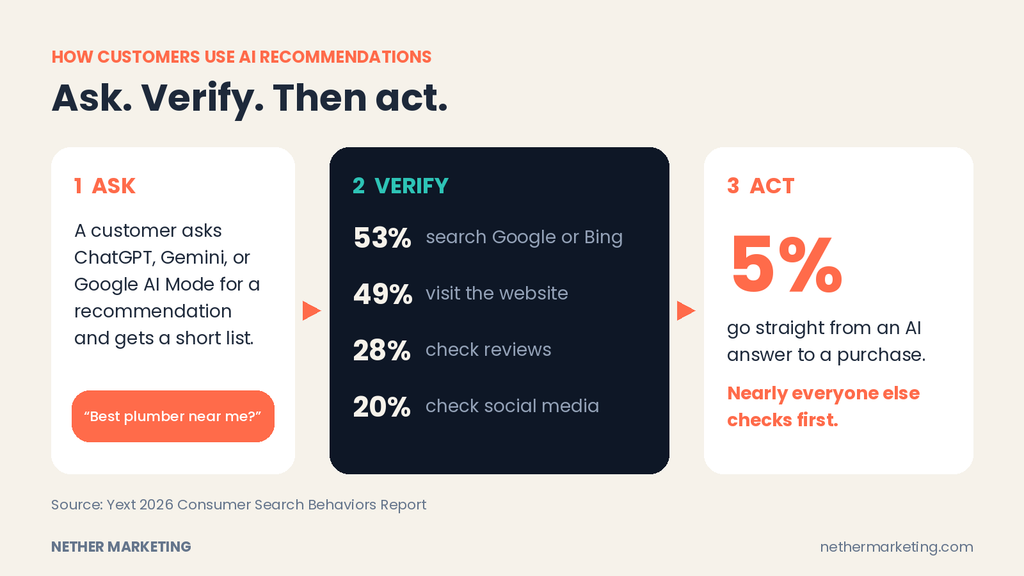
Most customers verify an AI recommendation before they buy, and your website is one of the first places they check.
Try This: The 10-Minute AI Visibility Check
Before you change anything, find out where you stand. Open ChatGPT, Google’s AI Mode, and Perplexity, and ask each one the same questions your customers would ask:
- “What’s the best [your service] in [your city]?”
- “Who can help me with [a specific problem you solve] near [your city]?”
- “Is [your business name] a good choice for [your service]?”
- “How does [your business name] compare to [a competitor]?”
For every answer, write down three things: whether your business shows up, what the AI says about you (including your hours, phone number, and services), and which websites it lists as sources. Those sources show you exactly where AI is getting its information, and where you need to show up.
Run each question twice. AI answers change from one search to the next, so a single result is a snapshot, not a final verdict. Pay close attention to the facts, too. SOCi found that business contact details in ChatGPT’s answers were only about 68% accurate, which means roughly one in three recommendations included a wrong address, phone number, or hours. If AI is sending customers to your old phone number, that’s a problem worth fixing today.
6 Ways to Make Your Business Easier for AI to Recommend
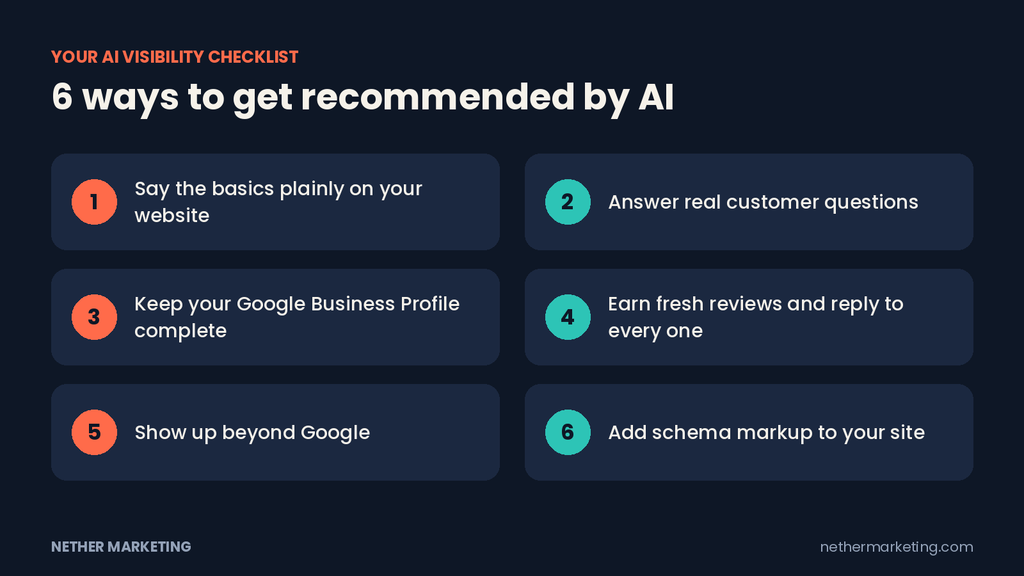
1. Say the basics plainly on your website
AI can’t read between the lines. Spell out your services, the areas you serve, your hours, and a starting price or price range if you’re comfortable sharing one. Put that information in real text on your pages, not inside an image or a PDF, and give each main service its own page that explains who it’s for and what’s included. A vague homepage might still work for a patient human visitor, but an AI tool looking for specifics will simply move on to a competitor that stated them clearly.
2. Answer the questions customers actually ask
Make a list of the questions you hear on the phone every week, then answer them on an FAQ page or in blog posts. Google’s guidance for its AI features emphasizes original, useful content that reflects real experience over generic advice anyone could write. Your specific answers, pricing examples, and lessons from real jobs are exactly what sets you apart.
3. Treat your Google Business Profile like a second homepage
Gemini and Google’s AI features lean heavily on Google’s own business data, so keep your profile complete: the right categories, current hours, real photos, and a description that matches your website. Make sure your business name, address, and phone number are identical on your website, your profile, and every directory listing.
4. Keep fresh reviews coming, and reply to all of them
Reviews are one of the strongest trust signals for both AI and people. BrightLocal found that 74% of consumers look for reviews written in the last three months, so a stack of great reviews from 2022 doesn’t carry the weight it used to. Make asking happy customers for reviews part of your routine, and reply to every review, good or bad, in a personal way. In SOCi’s data, the average business responds to fewer than half of its Google reviews, which makes consistent replies an easy way to stand out.
5. Show up beyond Google
ChatGPT’s local answers tend to draw more on Bing’s search index, Reddit, and directory sites than on Google. Claim your Bing Places listing, and keep your profiles on Yelp, the Better Business Bureau, and any directories specific to your industry accurate and consistent. Each accurate listing is one more place AI can confirm who you are.
6. Add schema markup to your site
Schema markup is behind-the-scenes code that labels your business details, such as your name, address, hours, services, and FAQs, so search engines and AI tools can read them without guessing. LocalBusiness and FAQPage schema are good places to start, and most WordPress SEO plugins can add them without custom code. Just make sure the markup matches what visitors can actually see on the page.
Save this checklist and work through it one item at a time.
Don’t Fall for “AI SEO” Shortcuts
Whenever something new shows up in marketing, someone starts selling a shortcut. Be cautious of anyone who guarantees your business will be recommended by ChatGPT, or who suggests stuffing keywords or hidden text onto your pages. Google has said plainly that appearing in AI Overviews or AI Mode doesn’t require any special tricks, and the same fundamentals behind good SEO still apply. The businesses AI recommends are accurate, active, well reviewed, and clearly explained. There’s no hack for that, just consistent work. If you’re still building those foundations, start with why most small businesses fail at marketing.
Get on the Shortlist, Then Win the Click
AI search is changing where the customer journey starts, but not what earns the sale. AI builds the shortlist. Your website, your reviews, and your online presence decide who gets the call.
That’s good news for small businesses, because this game rewards clarity and consistency more than budget. A local company with a clear website, an up-to-date Google Business Profile, and a steady flow of fresh reviews can beat a much bigger competitor that hasn’t paid attention.
Start with the 10-minute check. Fix what’s wrong. Then make sure your website confirms every good thing AI says about you.
| Find out what AI is saying about your business. Nether Marketing will check how your business shows up in ChatGPT, Gemini, and Perplexity, flag anything that’s inaccurate, and show you the fastest fixes, free. Book your free AI visibility check → Ready for a website built for both people and AI? See our website packages → |
Sources
- BrightLocal, Local Consumer Review Survey 2026 (AI findings)
- BrightLocal, Local Consumer Review Survey 2026
- Yext, 2026 Consumer Search Behaviors Report
- Google, Search updates from I/O 2026
- Google, New opportunities, control and insights for website owners
- Pew Research Center, Google users are less likely to click on links when an AI summary appears
- Search Engine Land, SOCi 2026 Local Visibility Index coverage
- SOCi, Local visibility benchmarks
- SOCi, Local listings benchmarks (AI data accuracy)
- Search Engine Land, Steady Demand local AI citation study
- Google Search Central, AI features and your website